
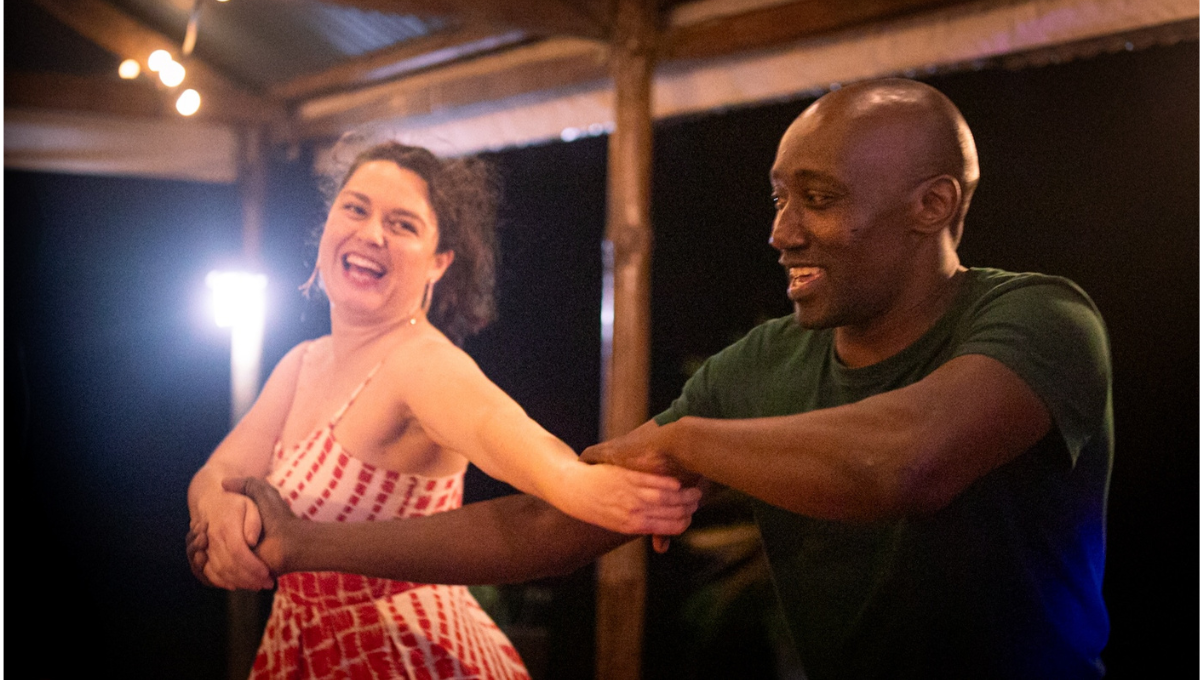
Have you ever felt so in tune with your dance partner that you’re sure you’ve somehow fused, and you’re moving as one entity? For me, this is the most euphoric moment of a dance, that perfect synchronisation: hitting the break in the music together, somehow, with no verbal communication, matching each other’s sweep or cheeky kick-ball-change. You wonder how you managed to read each other’s minds, or whether you’ve danced with that person so many times that you just know what’s coming next.
Science has now proved what we dancers have always intuitively known: when we’re in tune with each other, our brains sync up, helping us move as one.
In a unique study at the ATLAS Institute, Argentinian tango dancers wore electroencephalogram (EEG) caps, or devices that measure electrical activity in the brain. The results showed that when the dancers moved together in time, their brain activity looked startlingly similar. Scientists call this phenomenon “interbrain coupling” or “neural synchronisation.” Similar patterns have been seen in other social activities, such as playing duets on the guitar, but never before in dancing.
“When we dance, our brains are actually coupling,” said researcher Thiago Roque. “We are synchronising our brains through our behaviour.”

This extract comes from an article published in CU Bouldering Today journal:
When neurons fire in the brain, they create pulses of electrical activity, or “brainwaves.” EEG sensors measure those waves at different frequencies. Humans, for example, tend to produce fast pulses known as beta waves when they are concentrating or thinking hard. In contrast, they often generate slower theta waves when they’re relaxing.
Roque noted that how those waves behaved in the experiment depended on how in step the dancers were with each other.
When a leader, for example, took a step forward and the follower took an immediate (within 200 milliseconds or less) step back, their brain waves tended to match up — rising and falling at about the same time. When their steps weren’t in sync, neither were their brains. Those trends were true for a range of brain waves, including beta and theta waves.
“When I started seeing the results, they were perfect,” Roque said. “The coupling was even better than I expected.”

But why does it feel so good?
Humans have a natural impulse to synchronise their movements with other humans. Have you ever noticed yourself nodding your head, touching your face or folding your arms along with the person you’re talking to? Bronwyn Tarr, who is a trained dancer and evolutionary biologist at the University of Oxford, says, “It’s as if we’re all searching for a common rhythm to share” (Aeon). According to Tarr, when you observe another person moving, an area of the brain is activated which helps you make these movements yourself. The mutual mimicking of another person’s movements causes similar neural networks in both parties to open up a rush of neurohormones, which make us feel good.
And you know from your own experience how good it feels when you synchronise, when you fall effortlessly into each other’s rhythm, co-creating a flow state that transcends mere movement.

