

When I first started learning swing dance, I was focused on the steps, the spins, and keeping time (and also on not making a fool of myself!). But as I grew in confidence, relaxed, connected to the music, and tuned into my lead, I noticed something unexpected: a space emerging. A space between the rhythm, the moves, the two people dancing: a kind of silent dialogue that felt strangely familiar.
At first glance, swing looks like a story of leader and follower; one gives direction, the other responds. But the real connection happens in the invisible space between them: the shared rhythm, the tiny adjustments, the playful give-and-take. Swing dancers often talk about “connection,” but what they’re really naming is this sacred space between. It’s not mine, and it’s not yours – it’s ours (for the dance). Relationships work the same way. True connection grows in the space between, where dialogue happens, trust, understanding, and vulnerability co-exist, missteps become opportunities, and something larger than either partner emerges. Connection isn’t about control, perfection, or even skill. It’s not about the lead or the follow, or one or the other partner, but what arises between them – a living, co-created space where presence, trust, and playfulness come alive.
In my daily life, I work with relationships – helping people communicate, build trust, and connect more deeply- and it’s intriguing to see how swing dance mirrors important relational concepts.
Swing as a Conversation
The more I learn about swing, the more I notice that every step is really part of an ongoing conversation. A gentle pressure in the hand, a shift in weight, a shared pause before the music carries both partners forward again. The lead proposes, the follow responds, and together, in that fleeting moment on the dance floor, they create a story neither could tell alone.
It’s a story built on presence, trust, listening, responding, respect, and fun. This art of connection mirrors how we best meet each other in relationships. Deep bonds grow from the same back-and-forth rhythm: showing up, listening, understanding, and both partners taking responsibility for the space they share. This is where the real magic happens.
The Lost Art of Presence
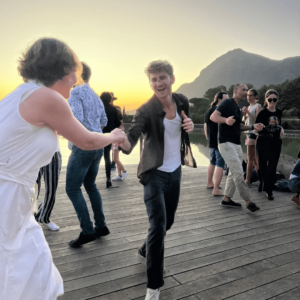
In swing, you cannot be half-there. A glance, a hand gesture, a shift in direction demands full attention. There is no space for to-do reminders, checking phones, or the distractions of daily life. True connection requires us to be fully present – whether on the dance floor or in our relationships.
In our fast-paced world, filled with deadlines, technology, and constant notifications, this kind of presence feels rare. Yet it is the lifeblood of connection. When we show up fully for one another by listening, noticing, and responding, the co-created space between us comes alive. Presence is what allows trust, play, and dialogue to flourish, whether in dance or in a relationship.
Non-Verbal Communication
In swing, so much of the conversation happens without words: the subtle shift in weight, a raised hand gesture, a shared glance. The lead offers a signal, clear but not forceful. The follower responds with their own expression, not submission, and shapes the dance as an equal partner. It’s a dynamic, silent dialogue, co-created in real time, neither passive nor dominating.
In relationships, it’s no different. Most of what we communicate isn’t spoken at all. Studies suggest that only about 7% of making meaning comes from the actual words we use, while 93% of meaning is carried through our non-verbal communication. Through eye contact, facial expressions, tone & intensity, gestures, body language, proximity, and timing, we do the bulk of our communicating. Even in silence, we are communicating.
It’s in non-verbal communication that true connection emerges. When our words, non-verbal expressions, and presence align, trust deepens. And, like on the dance floor, when we stop trying to control the steps and instead truly listen – with our eyes, our hands, our awareness – the rhythm between partners begins to shift, and something alive and responsive takes shape.

Trust and Vulnerability
I’m learning that to follow in swing is to let go, and to lead is to guide. I smile thinking about how many times a lead has said to me, “Relax your arm.” Both roles ask for vulnerability: a willingness to listen, to give, and to be changed by the other.
Swing reminds me how essential trust is to creating a safe connection, and vulnerability allows it to deepen. The safer and more trusted a relationship feels, the more freely each person can express themselves. This means being open to another’s experience, allowing their view of the world to make sense within their reality, even when it differs from our own. It’s a gentle kind of faith: through listening, attunement, and respect, the two perspectives can move together without losing their individuality.
Connection Beyond Technique
I sometimes see dancers who know all the steps but never quite connect, and others whose technique is imperfect yet whose presence lights up the room. The same is true in relationships. Magic doesn’t come from seeking perfection or rehearsed lines; it comes from showing up fully in the moment.
Of course, there are skills to learn, techniques to practice, and processes to understand – both in swing and in relationships. But what transforms a sequence into a living connection is awareness, curiosity, and the willingness to respond, adjust, and stay attuned to the other person. Care and curiosity allow each dance, each interaction, to become unique and meaningful. In the end, connection happens not in flawless execution, but in presence, responsiveness (even through imperfection), and the co-created rhythm that emerges between two people.
Playfulness and Improvisation
Swing dance is joyfully unpredictable, with neither partner knowing exactly how it will unfold. In the space between, there’s laughter, surprise, and the freedom to make mistakes. When I mix up my 6 and 8 counts, step on my lead’s toes, or turn the wrong way, there’s always room for adjusting, pausing, and restarting (and gratitude for the generous dose of patience I get). Missteps aren’t failures. They become part of playful improvisation when needing to adapt, or adjust, and to keep moving together. What a lesson for relationships!

Playfulness is just as essential in relationships. Over time, work, family, and daily pressures can cause partners to disconnect from play, laughter, and spontaneity. Yet connections need and thrive in lightness, curiosity, and delight. Approaching each other with a playful, open spirit keeps dialogue alive, transforms mistakes into opportunities for growth, and reminds us that fun and joy are as important as trust and communication in sustaining a meaningful connection.
Swing dance reminds me that true connection is an alive, vulnerable, responsive energy shaped by two people. Relationships, like a swing dance, exist in this shaped energy. Whether your dance lasts three minutes or thirty years, both swing and relationships ask the same question: “Would you like to dance?” And by accepting the dance, what matters most isn’t a perfect step, but the shared creating, the rhythm, the trust, the laughter, the vulnerability, the joy, and the courage to stay present when missteps happen. The dance belongs to the space between – that living, co-created space, built together, moment by moment, step by step, dance by dance.


Comments 1
In April 2026, waar tegnologie ons dikwels skei, herinner hierdie artikel ons dat niks die menslike konneksie van ‘n gedeelde ritme kan vervang nie.
besoek ons Telkom University Jakarta